Darts That Cut Black by Barry Oretsky (1989)

Rehs Contemporary Galleries, Inc., New York City

“Lot Fleeing from Sodom “ 🔥 by #BenjaminWest 🎨 #1810 oil painting on panel owned by Detroit Institute Of Arts.
This is an original oil painting of Lot fleeing his city of #Sodom as #GOD⚡️ destroys the Valley area 🔥 where people are living wicked with vice.

This exhibition, Marshall’s first major retrospective in the United States, contains nearly 80 paintings, all of which contain images of Black subjects going about their daily business, presented with utter equality and humanity. A deeply accomplished artist, who makes ravishing paintings, Read the rest of this entry »

Cranbrook Art Museum
Karen Kain is a Canadian ballet dancer who trained at the National Ballet School of Canada. She later became the artistic director at the National Ballet School of Canada. This screenprint is based off a photograph of the dancer. The portrait is embellished with blocks of vibrant yellows, oranges, purples and blues.
The Karen Kain portrait is a colored screen print created with diamond dust on Lenox museum board in 1980. Karen Kain captivated Warhol as she did to audiences around the world who watched her as a principal ballet dancer in the National Ballet of Canada. The screen print was based off of a Polaroid taken by Warhol in his famed studio, The Factory.

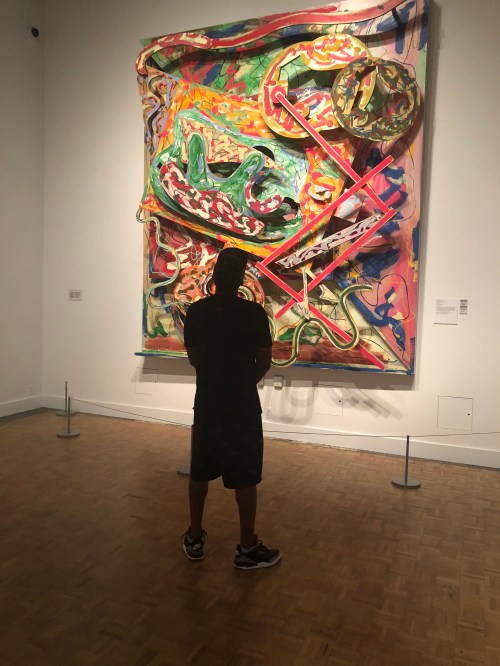
Frank Stella, in full Frank Philip Stella, (born May 12, 1936, Malden, Massachusetts, U.S.), American painter who began as a leading figure in the Minimalist art movement and later became known for his irregularly shaped works and large-scale multimedia reliefs.
Frank Stella works are influenced by Jasper Johns, Jackson Pollock, Barnett Newman, Franz Kline and Caravaggio. This 3 D Stella pictured above is one of my favorite paintings at the Detroit Institute Of Arts museum.
Photo 📸 Kim Bell

Detroit Institute Of Arts
“For want of a better model,” Van Gogh chose to paint his own portrait on many occasions. While in Paris between 1886 and 1888, Van Gogh lightened his palette under the influence of the brilliant colors of the impressionists, but he soon reserved the use of such light colors to express particular moods. Van Gogh’s stay in Paris was a relatively happy one, and in this painting, created during the summer of 1887, he portrays himself with an almost light-hearted appearance. This image above is located at the Detroit Institute Of Arts in Detroit,MI and was the first Van Gogh painting acquired in the United States. Van Gogh was one of the modern masters but didn’t receive his credit until he died.

Many of Jean-Michel Basquiat’s paintings are in some way autobiographical, and Untitled may be considered a form of self-portraiture. The skull here exists somewhere between life and death. The eyes are listless, the face is sunken in, and the head looks lobotomized and subdued. Yet there are wild colors and spirited marks that suggest a surfeit of internal activity. Developing his own personal iconography, in this early work Basquiat both alludes to modernist appropriation of African masks and employs the mask as a means of exploring identity. Basquiat labored over this painting for months — evident in the worked surface and imagery — while most of his pieces were completed with bursts of energy over just a few days. The intensity of the painting, which was presented at his debut solo gallery exhibition in New York City, may also represent Basquiat’s anxieties surrounding the pressures of becoming a commercially successful artist.
Photo 📸 Kim Bell

The Broad
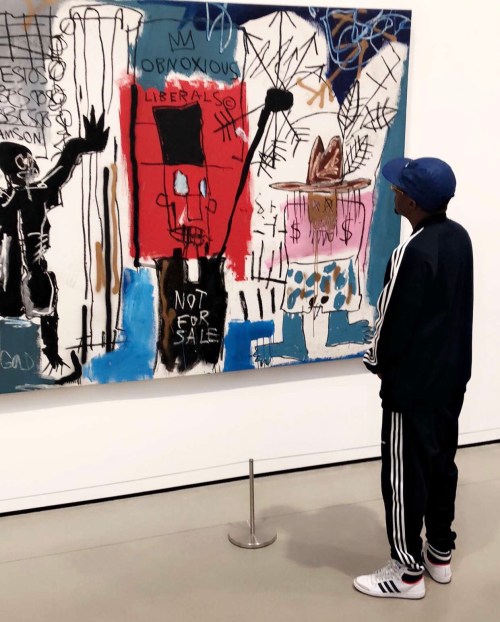
Jean-Michel Basquiat began his career as a wild-child, anti-establishment graffiti artist, and his rebellious stance is most graphically evidenced in his 1982 painting Obnoxious Liberals.
As the title suggests, Obnoxious Liberals depicts a series of figures representing capitalism and its hapless, powerless victims. The exploited, corroded victim, on the one hand, is virtually held hostage by the minions of mainstream White American culture, as represented by dollar signs, cowboy hats and Uncle Sam top hats as well as a “Not For Sale” sign. The victim’s dark skin also hints at the systematic oppression of African-Americans.
Basquiat was born in New York City in 1960 to parents of Haitian and Puerto Rican descent. The racial injustices he witnessed from an early age filled him with rage and the urge to rebel against the system. The political overtones of an indignant Jean-Michel are most obvious in Obnoxious Liberals.
Basquiat had no compunction about accompanying his visual art with written words expressing his intentions. Phrases, expressions, even nonsense syllables were acceptable to him as long as they helped him to convey his urgent, keenly felt messages to the public. For Basquiat, his message, the need to be understood, was just as important as the visual creation itself.
One of Basquiat’s main influences was Pablo Picasso, and this influence is notable in Obnoxious Liberals. The painting is clearly reminiscent of Picasso’s masterpiece Guernica and also portrays the atrocities perpetrated on the helpless victims by ruthless and unscrupulous authoritarian figures.
Although Basquiat’s creations often appear chaotic, as if he simply blew them out of his head on the spur of the moment, in fact, this is an impression which the artist himself strove painstakingly to produce.
The truth was that, in reality, he spent a great deal of time pondering over his canvases and carefully constructing in his mind what he wished to display, the disposition and lay-outs of his work and the messages he wanted to transmit.
The charismatic creator was a brilliant artist who knew how to employ vivid color for masterful effect. The use of primal, primary tones, splashes of raging red to attract the eye, glaring blue and black contrasting with pristine white and the almost complete absence of any other hues are some of the notable features of this painting.
Obnoxious Liberals, with its clear, confident strokes, is without a doubt a perfect example of Basquiat at his best.
Photo: Kim Bell

LACMA
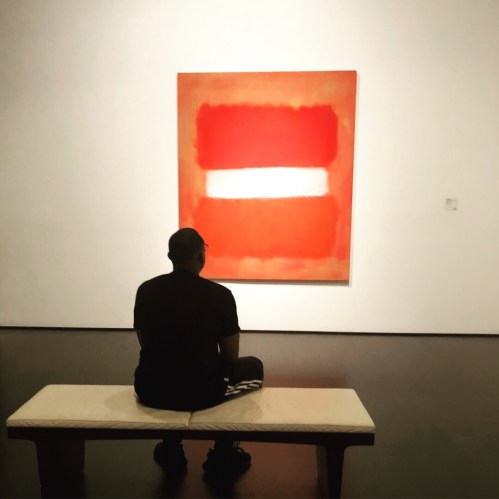
Abstract Expressionist Mark Rothko is known for the hovering, shimmering fields of color in his mature paintings. White Center reflects his fascination with the emotional and visual power of the color red, which dominates his canvases of the 1950s and 1960s. The red rectangles suggest ritual and elemental associations (blood and fire, life and death), while an inner light appears to emanate from the white center, suggesting an ethereal, numinous glow. For Rothko, color was key to a spiritual realm, evoking transcendental truths that could not be expressed through recognizable imagery.
Photo: Kim Bell

Detroit Institute Of Arts
Unlike his contemporaries Jackson Pollock and Mark Rothko, de Kooning’s paintings refer to natural forms and specific places or events, pushed into pure abstraction by his reliance on color and the deep build-up of paint to create form. Depth and perspective are subordinated to the flattening effects of his slashing, violent brushwork. Some of the “abstract landscapes” from 1957 to 1963 are based on the landscape around Long Island Sound, including Merritt Parkway, a local highway. Speed is suggested by the controlled thrusts of the brush while the naturalistic palette conveys the crisscross of the road through the landscape.
Photo: 📸 Kim Bell