Andy Warhol “Mao” (1972)
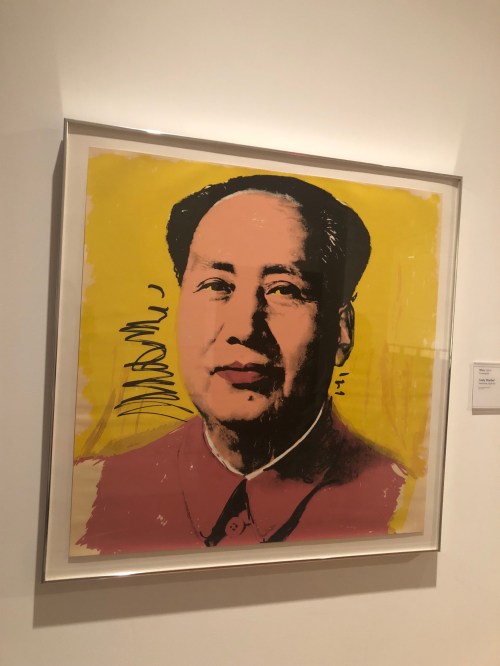
Artist: Andy Warhol (1928-1987)
Mao (Mao Tse Tung) 1972
Screenprint printed in color ink on wove paper 36×36
Kim Bell
Artist: Andy Warhol (1928-1987)
Mao (Mao Tse Tung) 1972
Screenprint printed in color ink on wove paper 36×36
Kim Bell

Hebru Brantley piece from his 2016 collection.

Mickalene Thomas (b. 1971)
“Something You Can Feel, 2008”
rhinestone, acrylic paint, and oil enamel on wood panels 96 x 120 in.
Acquired by Detroit Institute of Arts (2015-present)
photo: Kim Bell

Ed Ruscha (b. December 16, 1937) in Omaha, Nebraska.
One of the most important postwar artists, Ed Ruscha came into prominence during the 1960s pop art movement. First recognized for his associations to graphic design and commercial art, Ruscha became admired for his meditations on word and image. Working in a variety of media and taking the environment of Los Angeles as a guide, Ruscha creates candid, comic presentations of familiar ideas and locations that continue to impact contemporary art.


“Lot Fleeing from Sodom “ 🔥 by #BenjaminWest 🎨 #1810 oil painting on panel owned by Detroit Institute Of Arts.
This is an original oil painting of Lot fleeing his city of #Sodom as #GOD⚡️ destroys the Valley area 🔥 where people are living wicked with vice.
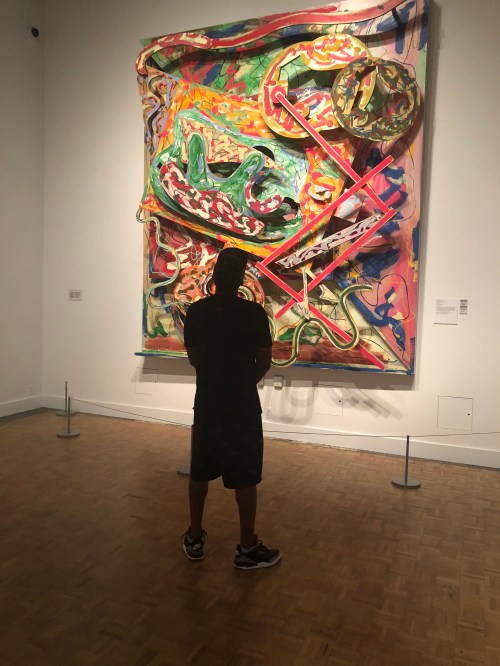
Frank Stella, in full Frank Philip Stella, (born May 12, 1936, Malden, Massachusetts, U.S.), American painter who began as a leading figure in the Minimalist art movement and later became known for his irregularly shaped works and large-scale multimedia reliefs.
Frank Stella works are influenced by Jasper Johns, Jackson Pollock, Barnett Newman, Franz Kline and Caravaggio. This 3 D Stella pictured above is one of my favorite paintings at the Detroit Institute Of Arts museum.
Photo 📸 Kim Bell

Beckmann often represented himself in disguise or costumed to express his own view that life is a series of roles to be played. In this late self-portrait, the artist seems to have shed disguise: unsmiling, he stands plainly dressed, close behind an easel. The figure is rendered in the strong black outlines characteristic of Beckmann’s rather flat painting style. Tight space presses in around the figure, conveying a claustrophobic sense that underscores Beckmann’s physical presence and close proximity. His gaze is challenging, but it also creates a sense of immediacy in its directness.
Photo 📸 Kim Bell

Detroit Institute Of Arts
“For want of a better model,” Van Gogh chose to paint his own portrait on many occasions. While in Paris between 1886 and 1888, Van Gogh lightened his palette under the influence of the brilliant colors of the impressionists, but he soon reserved the use of such light colors to express particular moods. Van Gogh’s stay in Paris was a relatively happy one, and in this painting, created during the summer of 1887, he portrays himself with an almost light-hearted appearance. This image above is located at the Detroit Institute Of Arts in Detroit,MI and was the first Van Gogh painting acquired in the United States. Van Gogh was one of the modern masters but didn’t receive his credit until he died.

 GWOP University